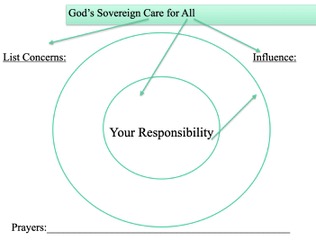

The Circle of Responsibility

God’s Circles of Responsibility: Trusting God’s Sovereign Care in Your Life

COUNSELOR’S TOOLBOX

At times, we are concerned about things that are completely out of our hands. You see, God has placed each of us at the center of the responsibilities He has entrusted to us. Rather than calling us to carry the weight of the whole world, or even interfere with other’s lives, making them less capable, He asks us to faithfully steward the people, opportunities, and assignments He has placed directly in our care. When we understand our God-given responsibilities, we experience greater peace, purpose, and freedom from unnecessary anxiety. And we become more responsible for our own lives.

Imagine your life as a series of concentric circles and list what concerns you in the tool above.

  • Center Circle – My God-Given Responsibilities
    • My relationship with God.
    • My character and choices.
    • My family commitments.
    • My work and daily responsibilities.
    • My stewardship of time and resources.

  • Second Circle – My Influence
    • People I can positively influence.
    • Living out my responsibilities as an example of God’s grace.
    • My influence through encouragement and obedience.
    • Trusting God while fulfilling my own calling.

  • Outer Circle – My Concerns
    • World events and issues beyond my control.
    • Matters outside my personal responsibility.
    • Praying and responding wisely, without carrying unnecessary burdens.
    • Focusing on my responsibilities frees me to do God’s work.

Read Psalm 8 “How Majestic is Your Name” and Take a few moments to reflect:

When I look at your heavens, the work of your fingers, the moon and the stars which you have set in place, what is man that you are mindful of him, and the son of man that you care for him? Yet you have made him a little lower than the heavenly beings and crowned him with glory and honor. You have given him dominion over the works of your hands; you have put all things under his feet…”. (vs. 3-6).

What concerns occupy your mind that are truly outside your control?

Write them down. Then consciously place them into God’s hands, acknowledging that His wisdom, power, and providence far exceed your own.

Read Psalm 9, Extract who God is and who are you, list them then ask God, “what is my just cause?” (vs.4). Is this your responsibility or another’s? It could be your just cause.

Now write out Prayers that can assist your growth:

Fill in the Blank, Prayer to get you started with what is your responsibility and What I need to trust God in and for:

Heavenly Father, I surrender ___________ and every burden that is beyond my control. Teach me to faithfully carry only the responsibilities You have given me and to trust Your sovereign care over everything else. Amen.

Think: What do I need more Confidence in:

Lord, strengthen my confidence in  ___________ and that You rule over all the earth. Even when circumstances seem uncertain, remind me that You are working according to Your perfect wisdom and unfailing love. Help me rest in Your providence today. Amen.

Pray in Faithfulness:

Father, help me be faithful in the center of my circle of my God-given responsibility. May my life influence others through humility, love, and obedience, while I leave the outcomes in Your capable hands. I trust You to accomplish what only You can do while working in me. Amen

Posted in Uncategorized | Tagged , , , , , | Leave a comment

Finding Freedom Through Forgiveness

COUNSELOR’S TOOLBOX

Steps to Forgiveness

Let me share with you a simple three-step method of therapeutic release that can help when you are carrying bitterness or resentment toward someone who has harmed you. This practice has developed over time, and its strength is in its simplicity.

I was first introduced to this approach while learning alongside creative missionary friends at Novo during an Activating Prayer Cohort. In that setting, we explored several forms of prayer. One of them was Inner Healing prayer, which includes learning how to forgive others, renouncing harmful vows we may have made, and bringing childhood wounds before the Lord for healing.

At the center of this practice is forgiveness. Although of primary importance, asking God to forgive us through the saving work of Jesus on the cross is not our only need. Also, the forgiveness of others and forgiveness of self brings us to fruition of our faith, moving us into sanctifying grace. Below is a method addressing the forgiveness of others.

Jesus teaches us in Matthew 6:14,15 that forgiveness has multiplying effects.

The New Living Translation reads;

Your heavenly Father will forgive you if you forgive those who sin against you; but if you refuse to forgive them, he will not forgive you.” 

2 Types of Forgiveness:

It helps to understand that there are generally two streams of forgiveness.

First, there are moments when someone who has harmed you becomes aware of their wrongdoing. They may come to you with genuine repentance and a desire to reconcile. In those cases, forgiveness can grow through conversation, humility, and time.

But there is a second situation that many of us experience more often. Sometimes the person who hurt us does not acknowledge what they have done. They may be unaware, unwilling to admit it, or simply unavailable. They may even be someone you can no longer speak with because they are distant, unsafe, or no longer living.

In those moments, forgiveness becomes something you do before the Lord. It is not dependent on the other person’s response. Instead, it becomes a way for you to be released from the prison of un-forgiveness and the exhausting cycle of bitterness or rumination that can quietly damage the heart.  Jesus said, “The thief comes only to steal and kill and destroy. I came that they may have life and have it abundantly” in John 10:10.

If you choose to practice this exercise, begin with a simple prayer asking Jesus for His presence and covering. If possible, it can be helpful to do this with a trusted person such as a counselor, pastor, intercessor, or close confidant who can gently guide the process.

See to it that no one fails to obtain the grace of God; that no root of bitterness springs up and causes trouble,…”. Hebrews 12:15

Ask: Jesus, what are you showing me? Is there any sin or brokenness that has caused me to be bitter inside that needs forgiveness from you and also from me? What do you, Jesus, want to change in me? Is there someone I need to forgive?

Before speaking the words of forgiveness, take time to name the offense honestly. This step matters. Sometimes it takes quiet reflection with Jesus to fully recognize what actually hurt you.

Once you can clearly identify the person and the offense, you can slowly walk through these three statements, placing their name and the offense into the blanks.

Three Step Method:

  1. “__________, I forgive you for __________.”
  2. “__________, today I choose to no longer live in reaction to __________.”
  3. “__________, I release you from the prison of my unforgiveness. As I have been forgiven, so I forgive you, in Jesus’ name.”

Ask: How do you feel? What was the hardest part of this release? Do you need to do this again (70 x 7)?

These words are not about minimizing the wrong or pretending it didn’t hurt. Instead, they are about releasing your heart from being bound to the offense.

As you continue reflecting on forgiveness, consider taking some quiet time with the Lord.

Reflect on Colossians 3:12-14: “Put on then, as God’s chosen ones, holy and beloved, compassionate hearts, kindness, humility, meekness, and patience, bearing with one another and, if one has a complaint against another, forgiving each other; as the Lord has forgiven you, so you also must forgive. And above all these put on love, which binds everything together in perfect harmony.” 

Now, while contemplating your heart and even journaling a prayer, release the person who has offended you.

You might reflect on what stands out most to you about forgiveness. Many people discover that forgiveness is first a decision before it becomes a feeling. Others realize that forgiveness is not about excusing harm but about allowing God to bring redemption where pain once lived.

Have you already asked Jesus to forgive you? Then be free in Jesus and His forgiveness now.

Amen

Posted in Uncategorized | Tagged , , , , , , , , | Leave a comment

The Sweet Aroma of Christ 

Current image: The essence of Christ's aroma still lingers today

Even when Your jar is empty and after all you’ve been through, Jesus is anointed in Your life. The essence of scent from the woman’s perspective of Matthew 26:6-13:

I enter the house quietly, yet I hear my heart pound like thunder. The room hums with conversation, sandals shifting, voices rising and falling. And there is my Jesus. Oh how I love Him! He is so near that I can see the softness in His eyes and the strength He so confidently carries in His posture. I clutch the alabaster jar tighter. It is costly. It is precious. It is all I have saved for something meaningful… and suddenly I know: this moment is that meaning.

This will be an act of service and love.

My hands tremble — not from fear of the crowd, but from the overwhelming love stirring in my chest. He has seen me. Known me. Received me without shame. How could I not pour out everything?

I open the jar. And my hands form a faucet of a fountain of beautiful release flowing towards His head.

The fragrance rushes out, thick and sweet, filling the room before anyone can stop me. My hands continue to move instinctively, pouring the perfume over His head, letting it run down, letting it honor Him in a way that words never could. I’m still weeping knowing I belong to Jesus.The scent clings to my skin. It soaks into His hair. It settles into the air like a silent prayer of acceptance.

Voices interrupt — sharp, critical, practical. But I’m used to that by now. I’ve been pushed into silence before. I hear:

“Wasteful.”

“It could have been sold.”

“Given to the poor.”

Their words sting, but I do not pull back. Love does not calculate. Love recognizes worth and responds with surrender. I am not trying to be impressive. I am simply undone by my encounter with my Lord.

Jesus speaks.

His voice steadies the room and steadies my heart. He defends me — not just my act, but my intention. He sees what I meant, what I felt, what I offered. He names it beautiful. He receives it as preparation, as devotion, as love poured out at the right time.

In that moment I realize: the aroma rising in the room is more than perfume. It is worship. It is surrender. It is the scent of my life in Christ, regarding His worthiness and immense act of forthcoming love for the world.

And I understand something deeper, I did not anoint Him because I fully grasped what He said was coming. I anointed Him because His Spirit of love compelled me. Because my soul recognized His worth before my mind understood His suffering, I am free and forgiven.

The fragrance lingers long after the jar is empty. It clings to Him. It clings to me. It clings to the memory of everyone present.

Love leaves a scent. It is peace in the knowing, the knowing of Jesus.

Carry the scent with you.

Ask:

  • How might my life become the aroma of Christ today? What is my witness to the world?
  • Where can love be poured out rather than measured?
  • Who might encounter Jesus through the “fragrance” of my words, actions, or presence?

Lord Jesus,

Let my life become like the opened alabaster jar. Not guarded nor measured. Not held back. Teach me to recognize You so deeply that I pour out my devotion without hesitation. Let my worship be sincere, not strategic. Costly, not convenient. When others misunderstand, steady my heart. When I feel small, remind me that love offered to and for You is never wasted. May the aroma of my life — my prayers, my obedience, my affection towards others while sincerely following You, cling and unify us and point others toward Your beauty and peace in forgiveness. And when my hands tremble again, give me courage to pour out all that I am, until the whole world breathes in the sweet aroma of Christ. Amen

Send me an email at cindasaid@icloud.com if you would like a free Lectio Divina on this story.

Posted in Uncategorized | Tagged , , , , , | Leave a comment

The “U-Shaped” Gospel Application in Counsel

How can we apply the Gospel to Everyday Life?

Many believers confess with their mouths that “Jesus is Lord,” yet struggle to connect that confession with the small, ordinary moments of daily life. The gospel is not merely the doorway into salvation—it’s the pathway of transformation we walk every single day. Seeing the life of Jesus in your every day life comes from understanding the shape of the gospel in our life. This shape is a “U” shape.

Romans 10:8 proclaims that “the word is near you, in your mouth and in your heart.” The gospel isn’t distant or abstract; it’s present within “U”, the believer. Starting at the Incarnation of Christ, He descended into our broken world, lived a perfect and sinless life that we could not (2 Corinthians 5:21) and bore our sin on the cross (1 Peter 2:24). He died and was buried (1 Corinthians 15:3-5), resurrected and ascended to the Father—completing what Theologian Kevin Vanhoozer called the “U-Shaped Gospel*.” His descent into our pain and His resurrection life now shape our identity and our responses to daily challenges. We live out the gospel in Jesus’ life, death, resurrection and present position.

In biblical counseling, this truth becomes intensely practical. For example, when you face rejection, remember: Christ was rejected so that you could be accepted by the Father. When you are tempted to strive for worth through performance, rest in the finished work of Jesus, who fulfilled the law perfectly on your behalf. When you feel powerless to change, recall that the same Spirit who raised Jesus from the dead lives in you (Romans 8:11). Do you have His Holy Spirit living with in you?

The gospel reorients our hearts from doing for approval to living from acceptance. It reshapes how we think, feel, and act. Here are some examples:

  • In relationships: Jesus took away the sins of the world (1 John 2:22). We forgive because we’ve been forgiven (Colossians 3:13).
  • In work: We serve as unto Christ, not for human praise (Colossians 3:17).
  • In suffering: Jesus suffered and we too will suffer yet bear it in Christ (Luke 24:36, Acts 9:16, Romans 8:17, 1 Peter 2:20).
  • In seeking: Give me the mind of Christ so I see my position in you (Colossians 3:1-3).

Applying the gospel daily means confessing truth over our hearts instead of listening to lies. It’s reminding ourselves and joyfully living in that Jesus is enough—today, in this conversation, in this decision and we “confess it” to be truth. It’s remembering that righteousness is not achieved by law-keeping but received by faith as we live in the imputed righteousness only through the “U” shaped gospel in Jesus Christ.

So, speak it: “Jesus is Lord.” Believe it in your heart. Let His descent into your brokenness and His resurrection power lift you into new and eternal life. Every moment—mundane or miraculous—becomes an opportunity to live out the gospel’s “U-shaped” rhythm: life in Christ, death to sin, and at times; humility, persecution, surrender, and life in the resurrection hope as we are seated with Christ and as we await our final glorification.

PRAY: Jesus, I want to live for U each day. Show me how how your life is in me and where I am in my faith walk with U, what you have planned for my purpose on earth and how it relates to the finished work of the gospel. Give me your Holy Spirit, assist my life in U alone, help me die to my own sin, forgiven and forgiving. Would U bless me and heal me when I suffer, so that I can live in the power of the resurrection and be seated along with U now, as you have confirmed in scripture? In U, Jesus, I pray. Amen

*Taken from my “Confess It” Biblical Theology II paper at Westminster Theological Seminary, 2013.

#Ushapedgospel – What Jesus did 4 U belongs 2 U

Posted in Uncategorized | Tagged , , , , , , , , , , | Leave a comment

Understanding The Heart of A Turtle: Biblical Insights for Christian Counselors

The current image has no alternative text. The file name is: image.png

TOOLBOX for Counselors

At the heart of everything we do is the Honu (Turtle)- the Hawaiian symbol for longevity and spiritual wisdom rooted in an eternal oneness between land, people and sea.”  LAIRD

I was recovering from foot surgery in 2022 and watched a most excellent biography on YouTube on the life of Laird Hamilton called “Take Every Wave”. I am often inspired and always relish a biography for life understanding. I also take biographies with biblical analogy and relate how they can be used in personal growth and counsel of another. You know we don’t mimic or adapt another’s life (I won’t be riding a wave on Laird’s hydrofoil board any time soon) because God has created us all so uniquely and for a special purpose that is our very own. But Laird’s life story encouraged me to accept the challenge of recovery and as a water-exercise practitioner myself, to allow the natural element of water to strengthen me then.

Earlier in my life, precisely in 1976, my dad was one of our swim team coaches, and during that time, he shared a book with me called “Character Sketches—Pages of Scripture Illustrated in the World of Nature.” Besides Bible characters related to various animals, the book also taught me analogies and concepts from our Creator in anything of His good earth. Amazingly, I still have that book in my home library and have shared it here and there over the years, and I will do so again this summer with my grandsons as we talk turtles, turtles, and more turtles! To them, I am “Nonna and her turtles”!

Naturally for me, “the turtle” has become an increasing conceptual theme I’ve loved for over a decade and blends well with the “Draw a Picture” or “Discuss a Photo” tool to  spring board discussion for heart and character issues during counsel and with scripture:

Here’s how: 

1. The Shell – Self-Protection and Fear

Analogy: A turtle hides in its shell when it senses danger. Likewise, people often retreat emotionally, spiritually, or relationally when they feel threatened, hurt, or ashamed. (Ask: Is there something you are afraid of, hiding from or ashamed of?”).

Counseling Point: While some protection is natural, staying in the “shell” could lead to isolation, bitterness, and a lack of vulnerability. God wants us to trust Him and peak out of our protective shells. God offers a better refuge than our own defenses. Instead of hiding, we are invited to bring our fears and wounds into the light of Christ and His people (James 5:16).

“God is our refuge and strength, a very present help in trouble.” (Psalm 46:1)

“Perfect love casts out fear.” (1 John 4:18)

2. The Slow Pace – Growth Takes Time

Analogy: Turtles move slowly, but they do keep moving forward.

Counseling Point: Spiritual growth, healing, or overcoming sin patterns often feels slow. That’s okay—God is patient, and He calls us to perseverance. God values steady faithfulness. Don’t despise slow progress—celebrate it. Stay the course with Him.

“He who began a good work in you will bring it to completion…” (Philippians 1:6)

“Let us not grow weary of doing good…” (Galatians 6:9)

3.  Hard Exterior, Soft Inside – Emotional and Spiritual Vulnerability

Analogy: A turtle looks tough on the outside but is tender and soft inside.

Counseling Point: Christians are often taught to appear strong, but this can hide emotional wounds or struggles. God is not looking for outer strength but inward surrender. He desires honesty and humility over toughness.

“Man looks on the outward appearance, but the Lord looks on the heart.” (1 Samuel 16:7)

“A broken and contrite heart, O God, you will not despise.” (Psalm 51:17)

4. The Shell is Carried Everywhere – Carrying Burdens

Analogy: A turtle carries its shell wherever it goes—it can’t lay it down.

Counseling Point: Some burdens seem like they can’t be put down—chronic struggles, past trauma, or long-term consequences. Even if the burden doesn’t go away, Jesus walks with you. He sustains you under the weight, and sometimes He even transforms it into something redemptive.

“Cast your burdens on the Lord, and He will sustain you…” (Psalm 55:22)

“Come to me… I will give you rest.” (Matthew 11:28-30)

5. The Journey – Heading Toward the Goal

Analogy: A turtle may not move quickly, but it keeps heading in the right direction.

Counseling Point: Progress in the Christian life isn’t about speed but direction and persistence in faith. Keep your eyes on Christ. You may be slow, tired, or carrying wounds—but He is both your destination and your strength for the journey.

“Let us run with endurance the race that is set before us, looking to Jesus…” (Hebrews 12:1–2)

More TOOLS to  Use in Counseling

Journaling Prompt: “In what areas of your life do you feel like a turtle? Where are you hiding, slowing down, or carrying something too heavy?” Listen to God in prayer, what is he showing you in your heart? Write it out, accept it and move along in Him.

  • Prayer: Invite God to be the true shell, your refuge, your strength. Dear Lord, How I have _______________in my shell. Would you assist me in the Holy Spirit to trust you to ____________ so I can steadily move in Your care alone? I trust you now, Amen

Homework: Meditate on Psalm 91, imagining God’s wings as your new ‘shell.’ Contemplate His protective love for you!

At the heart of everything a biblical counselor does, is the Triune God; Father, Son and Holy Spirit who creates a oneness in you to accept the loving relationship He established before the foundations of the world. Embrace Him in your ministry and life.

Posted in Uncategorized | Tagged , , , , , , , , , , , | Leave a comment

Do you know?

The current image has no alternative text. The file name is: image.png

Posted in Uncategorized | Leave a comment

Living Water

On Being Well

“The Lord sustains them on their sickbed and restores them from their bed of illness.” Psalm 41:3

Who do we look to for advice when things go sideways or when our health fails? Is our first “call” to Jesus to govern our care? Or the doctor—-asap!!! I know many, including myself, who reach out to a friend who may respond to our distress, hoping for comfort and care and consoling words to confirm our suffering is real. But there is a friend who is closer than a brother—-It’s our brother, the Lord Jesus Christ—also known to many as Jehovah Rapha, the God who heals. We can trust that He will oversee our plights.

“Jehovah”, which comes from the Hebrew word “Havah” can be translated as “to be” or “to exist” or “to become known”. Our LORD is known by us and He knows us. By adding the Hebrew  “Rapha”, Jehovah-Rapha means “to restore” or “to heal” in faith, to be healed now and to know His healing. One of the first times God revealed Himself as our Healer was through a miracle that some may, today, call a chemical experiment that saved the Israelites when they were freed from slavery in Egypt. As they wandered around the desert, searching for their promised land, God was able to make water drinkable from a bitter river by commanding them to throw a piece of wood into it so they could be healed.

Now let’s read the insightful Matthew Henry’s Commentary on this story in Exodus 15:22-27:

“In the wilderness of Shur the Israelites had no water. At Marah they had water, but it was bitter; so that they could not drink it. God can make bitter to us that from which we promise ourselves most, and often does so in the wilderness of this world, that our wants, and disappointments in the creature, may drive us to the Creator, in whose favour alone true comfort is to be had. In this distress the people fretted, and quarrelled with Moses. Hypocrites may show high affections, and appear earnest in religious exercises, but in the time of temptation they fall away. Even true believers, in seasons of sharp trial, will be tempted to fret, distrust, and murmur. But in every trial we should cast our care upon the Lord, and pour out our hearts before him. We shall then find that a submissive will, a peaceful conscience, and the comforts of the Holy Ghost, will render the bitterest trial tolerable, yea, pleasant. Moses did what the people had neglected to do; he cried unto the Lord. And God provided graciously for them. He directed Moses to a tree which he cast into the waters, when, at once, they were made sweet. Some make this tree typical of the cross of Christ, which sweetens the bitter waters of affliction to all the faithful, and enables them to rejoice in tribulation. But a rebellious Israelite shall fare no better than a rebellious Egyptian. The threatening is implied only, the promise is expressed. God is the great Physician. If we are kept well, it is he that keeps us; if we are made well, it is he that recovers us. He is our life and the length of our days. Let us not forget that we are kept from destruction, and delivered from our enemies, to be the Lord’s servants. At Elim they had good water, and enough of it. Though God may, for a time, order his people to encamp by the bitter waters of Marah, that shall not always be their lot. Let us not faint at tribulations.

When was the last time you enjoyed our Living Water?

When we suffer, we go through a dry desert of inner-quandry, often deceiving ourselves through inner self-condemning  thoughts. Or maybe you are carrying someone else’s guilt? Or overthinking an issue? The pain you endure has a metaphysical component of thought. But God, through His loving Son, Jesus and the Holy Spirit will fill us with living water (John 4:10-11, 7:37-38) and repair our wrongful inner views of self, giving us the mind of Christ (1 Corinthians 2:16). His voice through the Word and the Spirit realigns us to what is indeed true and good in our lives while causing us to lay down our sinful pride or self-righteousness, or when we only depend upon ourselves (or our nearby advisors through texting) or the world and not His knowledge and work in us through the Holy Spirit.

When was the last time you asked your able and available Jehovah-Rapha to heal you? I’m here for you, so contact me to be counseled towards health and wholeness in Christ. He is the one that fulfills us as no one else can. Cindasaid@me.com

“He heals the brokenhearted and binds up their wounds.” Psalm 147:3

My peace I leave with you; my peace I give you. I do not give to you as the world gives. Do not let your hearts be troubled and do not be afraid.” John 14:27

Posted in Uncategorized | Tagged , , , , , | Leave a comment

Will you give me a drink? John 4:5-10

Jacob’s well—-a place to go or a place to avoid? For Jesus, it was a place to go and ask for a cool drink after a tiring journey on foot. He was alone and saw a Samaritan woman with an empty cistern about to draw water. As the Son of Man, he would become thirsty like you and me and the circumstances brought a divine appointment for her to experience living water through his personal inquiry.

In his day, research shows that when a man asked a woman for a drink of water, it could imply much more than a simple and kind beverage service. But she was trying to avoid others in the noonday heat. She had enough past husbands, and I think that she most likely did not want to have another.

In contrast, I wonder if Jacob did indeed meet his beloved Rachel at this very well (Genesis 29:1-14)?  The custom showed it was where you went to water your flock or socialize and find your future wife:

The incipient symbolism of the romantic meeting at the well is easy to see: the arrival of the man from a distant land represents the “otherness” of the relationship, the drawing of the water establishes a bond…” says Enslinger in his “The Wooing of the Woman at the Well..”.

After an exchange of discovery, the Samaritan woman is the one who receives the tall cool drink of satisfaction from Jesus, the long awaited Messiah— salvation through becoming known to her Savior. This fulfillment comes from a deep well that sweetly quenches the thirst of any parched mouth. And despite culture and past, Jesus’ unconventional way lands him at Jacob’s well, a place the disciples had learned to stay clear of. 

Jesus doesn’t avoid sinners, however. Quite the opposite. He proposes to them, bids them to come to him, the waiting bridegroom. He initiates conversation with you at the places he deems to do so, bringing joy and salvation to the one who receives Him. 

The Samaritan woman didn’t know then, but later Jesus would thirst again, to the extent of not being quenched when He hung on the cross to fully take away her sin and yours (Psalm 69:19-21, John 19:28). Like her, you can worship in spirit and in truth and tell others what Jesus has done for you. So take a cool drink or plunge deeply into the fountain of living water with Him. He waits for you in hope that his Bride, the church, will never thirst again. 

PRAY: Our consummate Jesus, we praise You for the fulfillment at Jacob’s well of the revelation of You, the Messiah Christ! You are the Bridegroom we sinners have longed for and need. We want to know You more and be known by You. Move us to not avoid people but instead to go to those who so desperately thirst. Amen

Posted in Uncategorized | Tagged , , , | Leave a comment

Cinda Marturano, M.A.

Cinda Marturano, M.A. Counselor and Advisor 

Cinda Marturano is a Master of Arts in Biblical Counseling from Westminster Theological Seminary and holds a Bachelor of Science in Business Administration from Villanova University. She has completed 3 levels of biblical counseling training with the Christian Counseling and Educational Foundation and holds an apologetics certificate from there as well. Since 2007, she has counseled those whom suffer with anxiety, depression, anger, as well as physical detriments. As the founder of Deep Waters Ministry, she manages grants given to discipleship, christian education, biblical counseling and caring projects locally and world-wide. Cinda receives each counselee as a unique creation. As we are created in the image of God and find redemption in Jesus alone, her methods bring a full picture of the Christian identity as it relates to the gospel. She counsels individuals, and not “labels” although medical professionals are of reference through out counseling for self-understanding. She has helped clients with methods of a prayerful and Christian perspective of the will of God in the work needed for continued growth in an individual; sanctification. Cinda charges on a sliding scale based on economic ability with a process of meeting twice before commitment is made on either end. You can meet in her home office in Malvern, PA or at your church or school, under the parent, pastor or principal’s knowledge of your care. Send an email to cindasaid@me.com for inquiry and availability processes.

Posted in Uncategorized | Leave a comment

“It’s Not About You”

When you counsel, advise and serve others, remember that it is God’s work through you. I am so thankful to my Lord Jesus for teaching me lessons of humility as it relates to being insulted and slandered while serving in the church. God certainly looks out for us when He calls us to love and serve others and I am grateful for the eye-opening experience of His call to servanthood for other’s sake, despite the pain. God gives us grace and wisdom when being sharpened in the cogs of the ministry wheel. I praise Him for teaching me what it means to travel from anguish in the Garden of Gethsemane “Lord, take this away”, to “but not as I will, but as you will”. May His sacrifice, not mine, be respected and glorified for all to see if he calls me to carry the cross. It’s about the gospel, not me.

After learning lessons of humility, the storm dies down and there is a peaceful confidence for me that no one can take away, a humble rejoicing. I didn’t want to go through an unusual indescribable situation but now I am nothing and I realize the joy in that. Prior to my big lesson of over 15 years ago, I thought it was up to me and my gifting, but now I realize that Jesus works undercover and our work may be unseen for others and His sake. It’s not about recognition, but His redemption through the gospel.

“Such is the confidence that we have through Christ toward God. Not that we are sufficient in ourselves to claim anything as coming from us, but our sufficiency is from God…”. 2 Corinthians 3:4,5 ESV

“He must increase while I must decrease (John 3:30)” is learned in true humility. In counseling, this means to obey God and follow His will through the Word while voluntarily submitting to His direction in the truth of the Spirit. Other times this means over-extending ourselves, putting others first and not demanding justice when wronged. At first, when I learned this meekness, I was astonished with the constant humility and self-deprecation, as something odd were happening (1 Peter 4:12). But the blessing in a counseling session that involves being humble is a true joy because He is right along side me, and through me He allows me to bring Him forward and together we see Jesus in action for the counselee; a matter of the heart. That makes me rejoice and smile because it’s not about us, it’s about His life and His glory in the lives of those we counsel. When others try to make it “about us”, we need to remember that God is showing them humility by bringing us to our knees, together. (written January 29, 2011 at Westminster Theological Seminary, “Counseling in the Local Church” with Dr. Tim Lane.)

Posted in Uncategorized | 1 Comment